German Riding Badges: How to Prepare and Pass the Exam
Reading time: 10 minutes
Do you dream of officially documenting your riding skills and opening doors to higher-level competitions or exclusive riding communities? Earning a riding badge (Reitabzeichen) is far more than a piece of paper: it is your key to a wider network and gives you access to events that would otherwise stay closed to you. Since the reorganization of the FN badges in 2014, the German Equestrian Federation (Deutsche Reiterliche Vereinigung, FN) has offered structured proof of achievement for all disciplines and levels.
Taking a riding badge means proving your competence to nationally uniform standards. Whether you are a returning rider who wants to formalize your skills or an ambitious rider planning the next step in your career, the FN badges create commitment and recognition across the entire equestrian scene.
Why a German riding badge strengthens your position
The German riding badge documents not only your riding ability but also teaches theoretical knowledge about horse keeping, health and ethics. According to the German Equestrian Federation (FN), more than 47,000 riders took a riding badge in 2022 alone, a clear sign of how relevant this qualification is.
With a valid badge, you can take part in competitions at the corresponding level. Riding Badge 5, for example, qualifies you for E-level dressage or E-class jumping tests. If you have higher ambitions, you will need Riding Badge 4 or higher for A-level classes and beyond.
Many exclusive riding clubs also give preferred access to members with proven qualifications. If you want to join an equestrian club that keeps high-quality lesson horses or regularly offers clinics with international trainers, for example, you will benefit from a current equestrian achievement badge.
Riding badge preparation: a systematic path to exam success
Preparing for a riding badge requires structured training in both theory and practice. The FN recommends at least three to six months of systematic training before the exam, depending on the level you are aiming for and your current training.
Practical preparation for different levels
For Riding Badge 5, the entry point to the official proofs of achievement, you must ride an E-level dressage test, tackle a course with a maximum height of 33 inches (85 cm) and complete a cross-country ride. Average preparation costs are around $900 to $1,300, including course fees and exam fees.
The requirements go up noticeably for Riding Badge 4: A-level dressage tests, jumping courses up to 39 inches (100 cm) and more advanced theoretical knowledge are required. Many riders book preparation courses with recognized instructors who specialize in FN exams.
Don't underestimate the theory
The theory part covers questions on horse keeping, feeding, health and animal welfare. Use the official FN textbooks such as "Richtlinien für Reiten und Fahren Band 1" (the German guidelines for riding and driving, volume 1) as your foundation. Online learning portals such as wehorse.com or reitverein-digital.de offer additional practice questions.
A concrete example: when asked about species-appropriate keeping, you should be able to explain precisely why an open stable or a box stall suits different types of horses and what minimum requirements the guidelines on horse keeping set out.
Taking a riding badge as an adult beginner: your way in
Adult beginners benefit especially from the tiered system of FN badges. The motivation badges RA 10 to RA 6 offer a gentle start without exam pressure. These badges are awarded after successfully completing courses and document your learning progress.
Only from Riding Badge 5 onward is there a formal exam with scoring. For adult returners or late starters, this step-by-step structure is ideal. Many riding clubs offer special adult courses that address the needs of this group.
According to 2022 FN statistics, the first-attempt pass rate for Riding Badge 5 is around 78 percent when preparation was structured. Without systematic training, that rate drops below 50 percent.
How do I prepare for a riding badge: practical strategies
The best riding badge preparation combines regular riding with focused study of the exam content. Plan at least three training sessions a week, with at least one under the guidance of an experienced instructor.
Training plan for the last eight weeks
Eight weeks before the exam, you should ride every exam element at least once a week. For Riding Badge 5, that means a complete dressage test, a course at exam height and a cross-country ride. Document your progress in a training journal and note where you can improve.
Four weeks before the exam, step up your training to four or five sessions a week. You should now also ride unfamiliar horses, since many exams use horses assigned by draw. This considerably trains your adaptability.
Mental preparation and exam nerves
The exam situation is very different from normal training. Simulate exam conditions by riding in front of spectators or signing up for practice exams. Many riding clubs organize mock exams where you can experience the process under realistic conditions.
Breathing techniques and visualization help control nerves. Picture yourself passing the exam successfully: this mental rehearsal has been shown to improve performance under pressure.
Which riding badge is right for me: determining your level
Choosing the right riding badge depends on your current level of training and your goals. A realistic self-assessment prevents frustration and improves your chances of success.
For riders who have taken lessons regularly for at least two years and can already ride confidently in all three gaits, Riding Badge 5 is the ideal entry point. If you already have show experience in E-level dressage or E-level jumping, you should aim straight for Riding Badge 4.
Riding Badge 3 is aimed at advanced riders with several years of show experience who have already ridden A-level tests successfully. More advanced knowledge of training theory and horse education is required here as well.
Specialized badges for your discipline
Besides the classic riding badges, the FN offers specialized achievement badges such as the dressage rider badge or the show jumping rider badge. These focus exclusively on one discipline and allow for deeper specialization.
Eventing riders have their own badge system that takes into account the particulars of this demanding combination of dressage, jumping and cross-country. Check www.pferd-aktuell.de for the current exam regulations.
Riding badge requirements and costs in detail
The formal requirements for taking a riding badge are clearly regulated. For Riding Badge 5, you need membership in an FN-affiliated club and proof of a Basis-Pass Pferdekunde (basic horse knowledge certificate) or an equivalent badge.
Total costs vary by region and provider. Expect the following ballpark figures for Riding Badge 5:
- Preparation course (3-5 days): $450-$750 including horse use and accommodation
- Exam fee: $90-$130
- Additional private lessons: $45-$65 per session
- Study materials and reference books: $55-$90
- Exam attire and equipment: $220-$550 (if you need to buy new)
Costs rise accordingly for higher badges. Riding Badge 3 can cost up to $2,200 with a preparation course and exam, especially if specialized trainers are involved.
Riding badge exam: how it works and tips for exam day
The exam follows a standardized format. The day usually starts with a written theory exam, followed by the practical parts. Plan for the entire day: exams typically last between six and eight hours.
Arrive at least 45 minutes before the exam starts to get to know the horse assigned to you by draw. This short warm-up phase is crucial for developing a feel for the horse. Watch how the horse responds to leg aids and how sensitive its mouth is.
Mastering the dressage exam
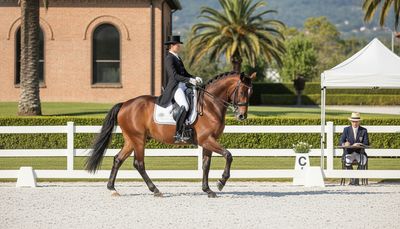
In the dressage exam, the relevant test is ridden individually or in pairs. The judges assess seat, aids and the correct execution of the movements. Ride the test at least 20 times beforehand, until it is second nature.
A common mistake: many candidates focus too much on the movements and neglect the basic seat. The judges first look for a balanced, quiet seat and only then for the details of the test.
Approaching the jumping course with a strategy
For the jumping part, you can usually walk the course beforehand. Use this time intensively: count the canter strides between the fences, memorize the turns and identify tricky spots.
A proven tip from experienced show riders: mentally ride the course three times before you mount. This visualization improves your orientation considerably and reduces the risk of going off course.
Community benefits: networking through equestrian achievement badges
Taking a riding badge opens doors to a community of ambitious equestrians. At preparation courses and exams, you make valuable connections with like-minded people who are pursuing similar goals.
Many successful show partners met at badge courses and later formed show teams for competitions. These networks are priceless if you want to expand your competition ambitions.
Badge holders also often get preferred access to exclusive clinics and training events. International trainers such as Ingrid Klimke or Ludger Beerbaum regularly offer courses that require a minimum badge.
Access to high-end riding facilities
High-quality private stables with first-class amenities often require a riding badge for entry. If you want to board at a private stable with luxury amenities, for example, you usually have to show at least Riding Badge 4.
This selection may seem elitist, but it creates a uniform standard of performance from which all boarders benefit. Training together on an equal footing and motivating one another are priceless advantages of such communities.
Passing the riding test: avoiding common pitfalls

Statistically, most candidates fail not because of their riding ability but because of avoidable mistakes. According to the 2022 FN exam statistics, the most common reasons for failing are insufficient theoretical preparation (34 percent), nerves in the practical part (28 percent) and poor knowledge of the test requirements (22 percent).
Don't leave learning the theory until the last week. Start the theory at least eight weeks before the exam and review the material regularly. Apps such as "FN Reitabzeichen" offer structured learning programs with exam simulation.
The right equipment for exam day
Your exam attire should be functional and compliant with the rules. Dark breeches, a light blouse or polo shirt, a riding jacket and tall boots are standard. Make sure the clothes fit well and you can move confidently in them.
Test your exam attire several times during training beforehand. Nothing is more unpleasant than discovering on exam day that your new breeches chafe or your boots pinch. All of your equipment should be complete at least two weeks before the exam.
After the riding badge: your next steps
Once you have passed your riding badge, a new chapter in your riding development begins. Use the qualification actively by entering competitions or attending advanced courses. The FN offers follow-up training such as trainer assistant courses or specialized continuing education.
Many successful riders plan their badges strategically: Riding Badge 5 in the first year, Riding Badge 4 in the second, collecting first competition successes in parallel. This structured progression creates continuous motivation and measurable progress.
Document your achievements professionally. A well-kept portfolio of badge certificates, competition results and proof of continuing education is valuable if you later want to work as a riding instructor or look for high-quality part-lease arrangements.
Frequently asked questions about taking a riding badge
How long is a riding badge valid?
FN riding badges are valid indefinitely and do not need to be renewed. However, many competitions and riding clubs require that the badge be no more than five years old, to ensure current ability.
Can I take a riding badge without club membership?
No, for FN badges from level 5 upward, membership in an FN-affiliated club is mandatory. Membership ensures that you are insured and recognize the FN's regulations.
What happens if I fail the exam?
You can retake the exam, but no sooner than four weeks later. The exam fee is due again. After a failed exam, many examiners give detailed feedback on how you can improve.
What benefits does the riding badge offer when buying a horse?
A current riding badge signals your competence and credibility to sellers. Especially for high-quality sport horses, breeders often ask for proof of achievement before they will even enter into sales talks.
Are there age restrictions for riding badges?
The minimum age for Riding Badge 5 is 12 years. There is no upper limit: adults over 50 or 60 can also take riding badges successfully, as long as the riding requirements are met.
Conclusion: invest in your riding future
Taking a riding badge is far more than a formality. It is your ticket to an active, well-connected equestrian community and opens doors to opportunities that would otherwise stay closed to ambitious riders. The investment in systematic preparation pays off many times over: through better riding skills, valuable networking contacts and access to exclusive events.
Start planning today. Contact your riding club, find out about the next exam dates at www.pferd-aktuell.de and book a preparation course. With structured preparation and the right mindset, you will take your riding badge and proudly present your new qualification.