Hay Quality: How to Spot It and Prevent Mold in Horse Feed
Reading time: 8 minutes
A single bale with mold in the hay can seriously endanger your horse's health. Even so, horse owners buy hay every day without really checking its quality. The consequences of moldy or dusty hay are serious: from chronic coughing to life-threatening colic. The good news: with the right knowledge you can judge hay quality and consistently prevent mold.
High-quality feed is not just a matter of horse keeping but also reflects your standard for a refined lifestyle. Anyone willing to invest in a top dressage horse or a premium pony shouldn't compromise on the daily staple feed either. Quality-conscious horse owners treat feed selection with the same care as buying a horse itself.
Use All Five Senses: Judging Hay Quality Like a Pro
Professional breeders and stud managers in Germany check hay systematically with all their senses. This method has proven itself for decades and is more reliable than many a lab analysis.
The visual check comes first. High-quality hay is greenish to slightly golden yellow. Brownish or even gray hay points to overly long storage or moisture damage. Pay special attention to white, gray or black spots in the bale. These are clear signs of mold in the hay.
The smell test is just as decisive. Fresh, good-quality hay smells pleasantly aromatic and slightly sweet, like herbs. A musty, moldy or sharply pungent smell signals problems. According to a 2021 study by the Free University of Berlin in Germany, horses cannot use up to 80 percent of the available nutrients in moldy hay.
The Hand Test Decides
Take a handful of hay and check the structure. Quality hay feels dry and crisp, never damp or sticky. The stems should feel springy and not break right away. If the hay crumbles to dust in your hand, it was either stored too long or dried incorrectly.
Shake the bale lightly. Clouds of dust are a warning sign of dusty hay, which is often loaded with mold spores. The German Equestrian Federation recommends a dust content of no more than three percent in hay.
Critical Buying Situations: How Do I Spot Bad Hay When Buying?
When you buy hay directly from the producer, you have the best control. Insist on cutting open several bales. Reputable farmers grant this look as a matter of course. If this check is refused, you should get suspicious.
The cutting time significantly influences horse feed quality. Ideal hay is cut at the stage of early grass flowering, typically from late May to mid-June in Germany; in the U.S., ask the grower about the cutting date and maturity in your region. Hay cut too late contains woody stems and fewer nutrients. Ask the seller specifically about the cutting date of the 2024 crop.
The seller's storage conditions give clues about the quality you can expect. Hay should be stored under cover, dry and well ventilated. Stacks directly on the ground or under leaky roofs are problematic. A 2022 study by the Haus Düsse Agricultural Center in North Rhine-Westphalia, Germany, showed that 37 percent of hay bales develop mold within six months when stored improperly.
Preventing Mold in Horse Feed Properly Through Optimal Storage
The best hay quality is useless if you store the feed wrong. Anyone who keeps a horse of their own needs a well-thought-out storage strategy.
Three factors decide successful hay storage: dryness, air circulation and ground contact. Hay must absolutely be stored under cover, ideally in a separate hay barn with enough distance from the stable buildings. Humidity should stay consistently below 60 percent.
Practical Storage Tips for Private Barns
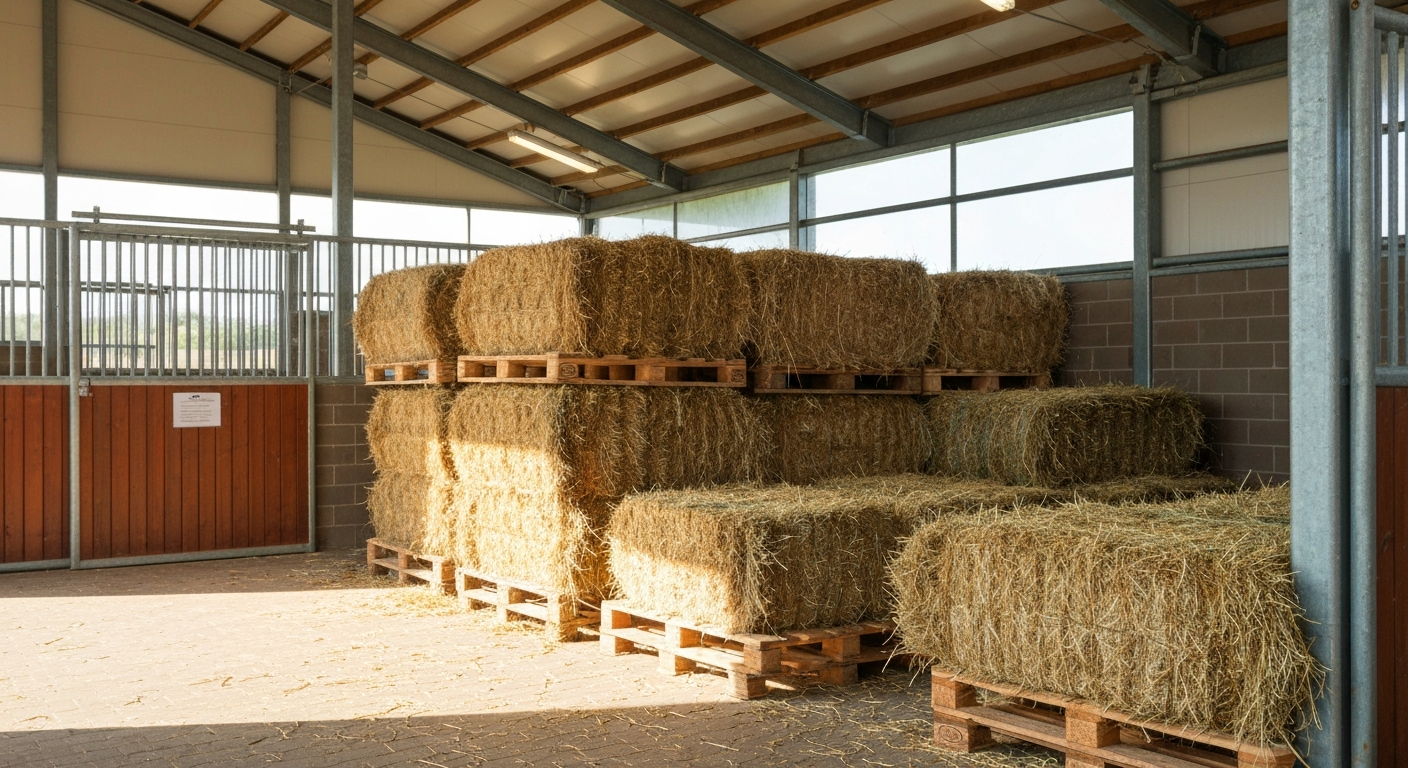
Never store hay bales directly on a concrete floor or on earth. Use pallets or special hay racks as a base. The distance from the ground should be at least 8 inches (20 cm). This simple measure effectively prevents rising moisture.
Stack bales with space from the wall. An air gap of 12 to 20 inches (30 to 50 cm) allows the necessary circulation. Make sure there is enough ventilation through windows or vents. Closed rooms without air exchange are breeding grounds for mold.
Check your supplies regularly. A weekly walk through the hay storage should be routine. Spot-check the core temperature of the bales. Temperatures above 104 °F (40 °C) indicate fermentation processes that can lead to mold.
Storing Hay by Season: Adapted Strategies

Storage conditions vary considerably between the seasons. In summer there is a risk of overheating, in winter of condensation.
During the summer months from June to September, ventilation is crucial. Open windows and doors in the cooler morning and evening hours. Avoid direct sunlight on the bales, since it reduces quality and promotes bleaching.
The winter months call for special care with temperature swings. When warm barn air meets cold outer walls, condensation forms. It can penetrate into the outer hay bales and trigger mold. Experts at the Institute of Animal Nutrition at the University of Hohenheim in Germany therefore recommend a minimum storage temperature of 41 °F (5 °C).
Special Cases: How Do I Spot Good Hay for My Horse With Respiratory Problems?
Horses with chronic coughing or COPD (heaves) need absolutely dust-free hay. Stricter quality standards apply here. Even slightly dusty hay, which would be acceptable for healthy horses, can cause problems for damaged airways.
For these horses, steamed hay or haylage is recommended as an alternative. Haylage has a higher moisture content of 40 to 50 percent and is practically dust-free. Storage differs fundamentally, however: haylage must stay airtight in plastic wrap and be fed within three days of opening.
Wet feeding is another option. The hay is soaked in water for 10 to 15 minutes. This method binds dust effectively but also leaches out water-soluble vitamins and minerals. With exclusively soaked hay, you should therefore expect to need an adjusted mineral supplement.
Financial Aspects: Quality Pays Off
High-quality hay in Germany costs between roughly $9 and $15 per 100 kilograms (220 lb), depending on region and season. This investment quickly puts itself in perspective when you weigh it against the cost of vet treatment for respiratory disease or colic.
The average costs of keeping a horse can be optimized through forward-looking feed planning. Anyone who buys larger quantities directly from the producer in summer often saves 20 to 30 percent compared with buying small amounts in winter.
Create an annual requirement calculation. A warmblood weighing 1,320 lb (600 kg) needs about 20 to 26 lb (9 to 12 kg) of hay daily. Over 365 days that comes to an annual need of around 7,900 lb (3,600 kg). Build in a buffer of 10 percent for quality losses.
Checklist for Buying Hay: These Points Have to Check Out
Structure your hay selection with a systematic checklist. You should tick off these points before every purchase:
- Cutting time is between late May and mid-June
- Color shows a greenish-golden tint without brown or gray spots
- Smell is aromatic and pleasant, never musty or moldy
- Structure feels dry, stems don't break right away
- Dust when shaking is minimal to none
- Seller's storage is under cover and off the ground
- Seller allows several bales to be opened for spot checks
- Price matches the regional market without striking deviations
Modern Analysis Methods: When the Sensory Check Isn't Enough
In cases of doubt, agricultural testing offices offer professional hay analyses. The LUFA (agricultural testing and research institute) in North Rhine-Westphalia, Germany, for example, carries out complete analyses for about $50. They test nutrient content, crude fiber content and microbiological contamination.
Such analyses are especially worthwhile for larger purchase quantities or when you are sourcing hay for valuable breeding horses. Results are typically available after 10 to 14 days and give detailed information about feed quality.
Portable moisture meters are available from about $90. This investment pays for itself quickly if you regularly buy larger quantities. The ideal moisture content is 12 to 15 percent. Values above 18 percent carry an increased risk of mold.
Frequently Asked Questions About Hay Quality
How do I reliably spot mold in hay?
Mold shows up as white, gray or black spots in the hay, accompanied by a musty smell. If you're unsure, a simple test helps: dampen a small amount of hay and seal it in a plastic bag for 24 hours. If a distinctly moldy smell develops, there is mold.
What hay quality does my horse really need?
Sport horses and broodmares need nutrient-rich first-cut hay with higher protein content. Recreational horses and hardy breeds do well with the lower-nutrient second cut. In every case, absolute freedom from mold and minimal dust content are decisive.
Can you still feed slightly moldy hay?
No, even low mold contamination seriously endangers horse health. Molds produce mycotoxins that can damage the liver and kidneys. Dispose of moldy bales completely. Picking out individual moldy spots isn't enough, because fungal spores permeate the entire bale.
How long can hay be stored without losing quality?
Under optimal storage conditions, hay keeps for 18 to 24 months. Nutrient content drops noticeably after about 12 months, however. So plan your supply for one season at most. Hay should be stored at least six weeks after harvest before you feed it, so that the sweating process is complete.
Are there regional differences in hay quality in Germany?
Yes, considerable ones. Regions with a balanced climate such as Lower Saxony or Schleswig-Holstein often produce higher-quality hay than rainy upland areas. The harvest time varies by up to three weeks between southern and northern Germany. Preferably buy regionally to minimize transport stress and quality losses.
Conclusion: Investing in Quality Safeguards Horse Health
Being able to judge hay quality is among the basic skills of responsible horse keepers. With trained senses, systematic checking and optimal storage, you reliably prevent mold in the hay. The extra cost of premium hay is minimal compared with possible vet costs from feeding mistakes.
Treat feed selection with the same care as buying your horse. Only anyone who doesn't compromise on the basics can enjoy a healthy, capable partner in the long run. Start today with a critical assessment of your current hay supplies and optimize your storage if needed. Your horse will thank you with vitality and health.